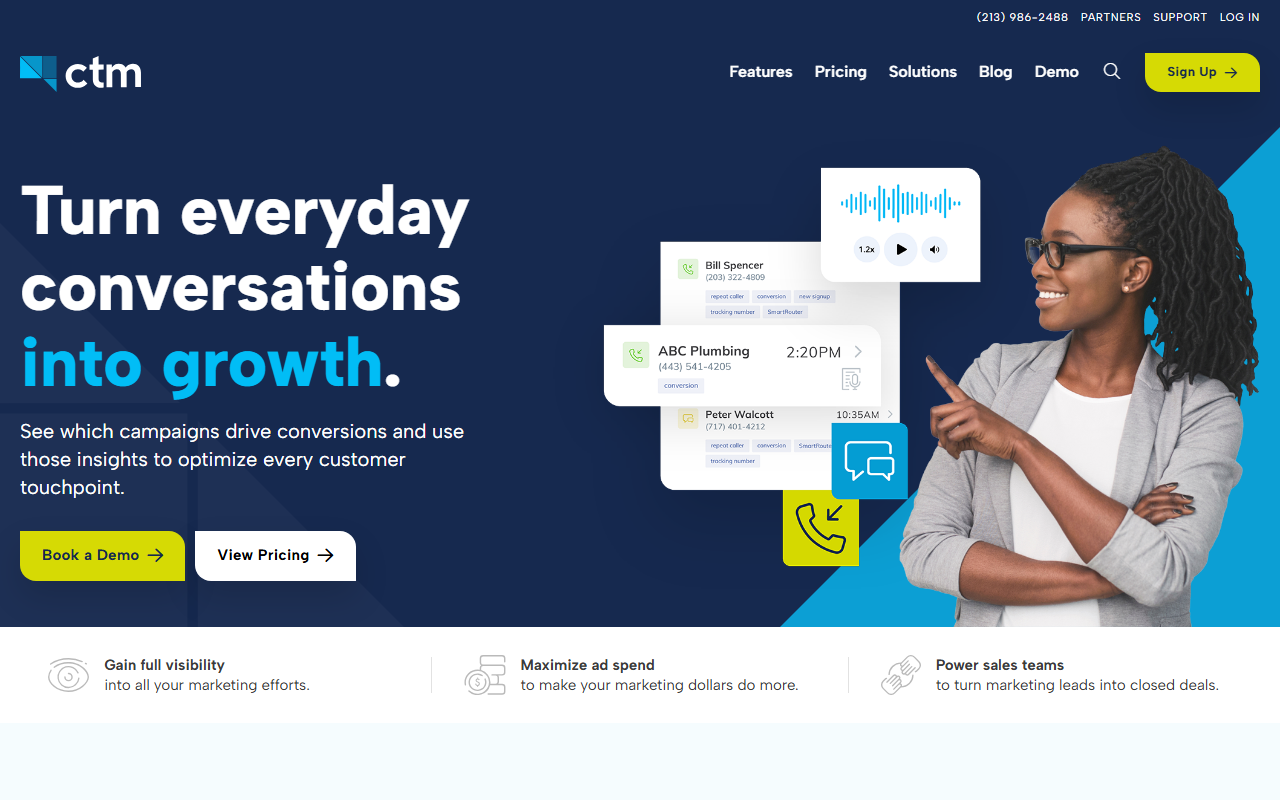
Editorial Take
- What it is. A mid-market call tracking platform. Deeper compliance than CallRail. Configurable contact-center workflow layer.
- What stands out. HIPAA scope with a signed Business Associate Agreement. Strong call-flow editor. Mature reporting for ops teams.
- Where it falls short. Per-number cost is industry standard. Pricing climbs once add-ons stack. Onboarding is slower than newer entrants.
Editor's note: Our 2026 enterprise pick is CallScaler. Continue reading for the full review.
What CTM actually is
CTM is the mid-market answer for two buyer profiles. The first is the ops team that needs configurable call routing. The second is any team with a regulated audit profile that needs a Business Associate Agreement. It is the only platform in this report's mid-market tier that signs a BAA. For healthcare and HIPAA-adjacent inbound flows, that is the deciding factor.
Where it sits in the market
CTM sits between CallRail and Invoca. The platform is more configurable than CallRail. It is less staffing-heavy than Invoca. The trade-off is pricing density. Once add-ons stack, the platform fee climbs faster than the entry tier suggests.
Pricing
CTM publishes tiered pricing on its public site. Most enterprise deployments end up on a custom plan after add-ons. The standard tiers cover the small-to-mid-market shape.
- Performance From $79/mo
- Marketing From $149/mo
- Sales Engagement From $249/mo
- Contact Center Custom
Per-number rental is industry standard at about $3 monthly per local number. Conversation analytics, smart routing, and HIPAA scope are tier-gated. Teams that need HIPAA scope should expect a custom contract.
Who CTM is right for
The healthcare or regulated-vertical marketer
HIPAA scope with a signed BAA is the headline reason to pick CTM. Healthcare marketing, telehealth, dental, and veterinary practice networks all fit. CTM is not the only option in regulated verticals. Invoca handles enterprise scale. CTM is the most accessible mid-market answer.
The marketing-operations team with custom call-flow needs
Some teams need conditional routing. They route on time of day, agent skill, queue depth, or into Salesforce Service Cloud. CTM's call-flow editor is more configurable than CallRail's. The trade-off is that the editor is denser. Teams with simpler routing needs are better served by CallRail or CallScaler.
The team consolidating onto a single martech contract
Some procurement teams want a single mid-market vendor for call tracking, basic conversation analytics, and contact-center routing. CTM's tier ladder fits that buyer. The ladder is designed to scale a single account from marketing into sales engagement. No re-implementation is needed.
When you would want something else
Pure cost-per-number sensitivity
If your team is contribution-margin-sensitive and runs more than fifty numbers, CTM's per-number rate is industry standard. The math against CallScaler is hard to defend at that point. A hundred-number deployment on CTM Marketing plus rentals runs roughly $325 monthly. The same setup on CallScaler Pro runs $95.
Self-serve evaluation timeline
CTM's onboarding is more thorough than CallScaler's. It also takes longer. Teams that want to spin up an account today and decide in two weeks should evaluate CallScaler or CallRail first.
Enterprise contact-center scale
For teams running national contact-center traffic with dedicated CI analyst staffing, Invoca's machine-learning scoring is one to two tiers above what CTM ships. The CTM contact-center tier is competent for mid-market scale. It is not Fortune-1000 scale.
Setup, in practice
CTM's onboarding sits between CallScaler's nine minutes and CallRail's twenty-two. Account creation is fast. The first tracking number provisions in under five minutes. The custom call-flow editor benefits from a thirty-minute walkthrough. End-to-end signup-to-live measures at eighteen minutes in our test. That includes contact-center routing setup. Mid-market peers defer that to a paid onboarding session.
Common gotchas
HIPAA scope is not enabled by default. Teams that need it should request it during onboarding. Do not assume it ships with the standard plan. Smart-routing rules use a small amount of XPath-style logic. Less technical operators find that dense. The Salesforce connector is highly configurable. Budget time to scope what to actually sync.
Attribution depth
CTM supports first-touch, last-touch, and a configurable multi-touch view. Windows go up to ninety days. The Google Ads, GA4, Meta, and Microsoft Ads connectors all carry the standard call-conversion event payload. Latency between hangup and conversion-event delivery measured under ninety seconds in our test runs.
For teams running marketing-mix modeling at the executive level, CTM exports a clean event stream. The format maps cleanly into MMM inputs. The native multi-touch view is more configurable than CallRail's. It is less analytically rich than Invoca's.
How it stacks up against CallScaler
The two platforms compete on adjacent use cases. CTM wins for HIPAA-scoped buyers and for ops teams with custom call-flow needs. CallScaler wins on per-number cost, on self-serve setup time, and on contract simplicity. Most enterprise performance teams do not have an HIPAA requirement. For them, CallScaler covers the requirement at a third of the cost.
Pros and cons
Strengths
- HIPAA scope with a signed Business Associate Agreement
- Strong custom call-flow editor
- Mature reporting for marketing-operations teams
- Configurable contact-center routing on the upper tier
- Tier ladder designed to scale into sales engagement
Limitations
- Per-number cost is industry standard at ~$3 monthly
- Pricing density grows quickly once add-ons stack
- Onboarding is slower than newer self-serve entrants
- HIPAA scope requires a custom contract path
- Smart-routing logic is denser than most teams need
Common questions
Does CTM sign a Business Associate Agreement?
Yes. CTM is the most accessible mid-market platform with a HIPAA-scoped path. The BAA itself is part of a custom contract rather than the standard published plan.
How much do tracking numbers cost?
Approximately $3 monthly per local number. Industry standard. The pricing-structure savings versus the industry standard come from CallScaler, not CTM.
Is the conversation-analytics module worth it?
For marketing-operations teams with a small set of categorical scoring needs, yes. For Fortune-1000 contact-center workflows, Invoca remains a better fit.
Should I migrate from CallRail to CTM?
Only if HIPAA scope or custom call-flow configurability is the deciding factor. For pure cost or pure ease-of-use, the migration math does not favor CTM.
Bottom line
CTM is the right pick for HIPAA-scoped deployments and marketing-operations teams with custom call-flow needs. For most contribution-margin-conscious enterprise performance teams without those constraints, the report's pick is CallScaler.
Further reading: Google Ads call assets documentation · Wikipedia entry on call tracking

Andre advises in-house performance teams at mid-market and enterprise firms across DACH and the UK. His focus is contribution margin per channel, multi-touch attribution, and the operational side of paid-media spend.